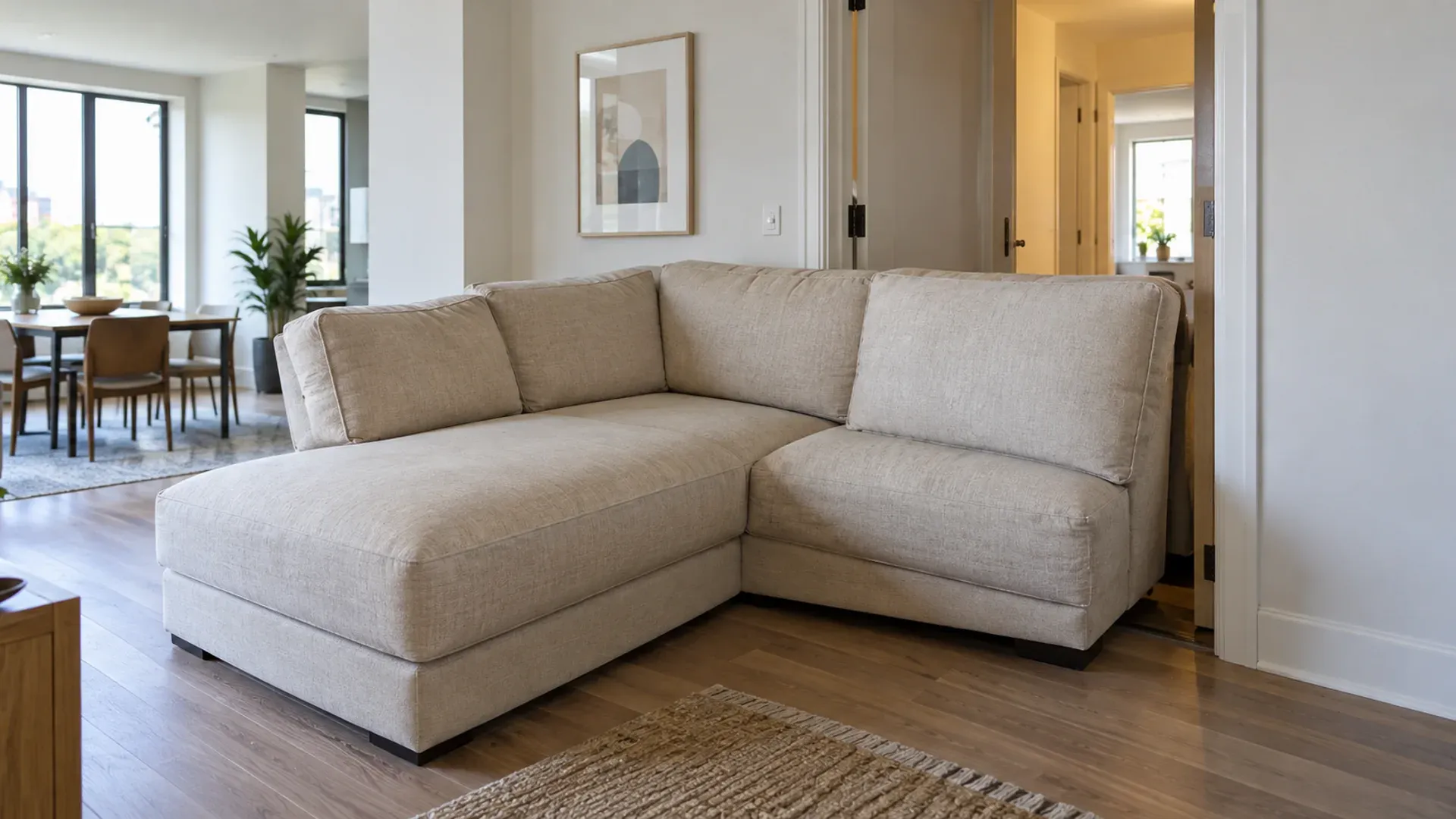
If a sofa will not fit through the door, stop pushing and assess the whole route before anything is forced. The answer may be as simple as removing loose cushions and changing the angle, but it may require separating modular sections, using another approved exit, or arranging careful dismantling. Send photographs and measurements before booking sofa removal so the provider can plan the job rather than improvise at the doorway.
The important question is not only whether the sofa is narrower than the door. Its length, depth, back height, arms, feet and shape all affect whether it can rotate through the opening and the turn beyond it. The route from the room to the loading point matters just as much as the first door.
Start by identifying the actual obstruction
Look at where movement stops. A sofa may pass through the door frame but fail at a tight corridor turn. It may clear the apartment entrance but not the lift. An L-shaped sofa may simply still be joined at its concealed connectors. Describe the first obstruction and every later constraint when requesting help.
Do not assume the narrowest-looking point is the decisive one. Measure the route and take wide photographs that show approach space. A close-up of the door alone does not reveal whether there is room to stand the sofa upright, rotate it or bring the far end around a corner.
Confirm what kind of sofa you have
Identify whether it is a straight two- or three-seat sofa, a corner unit, a chaise, a sofa bed, a recliner or a modular system. Look underneath only if it is safe and accessible. Separate sections, removable feet and transport brackets may change the plan, while a sofa-bed mechanism can make the item much heavier than it appears.
Share the make or model if known, but photographs are still essential. Furniture sold under one range can have several sizes and configurations. State whether you want the sofa disposed of or retained, because dismantling an unwanted item and protecting a sofa for reuse are different scopes.
Measure the sofa without moving it dangerously
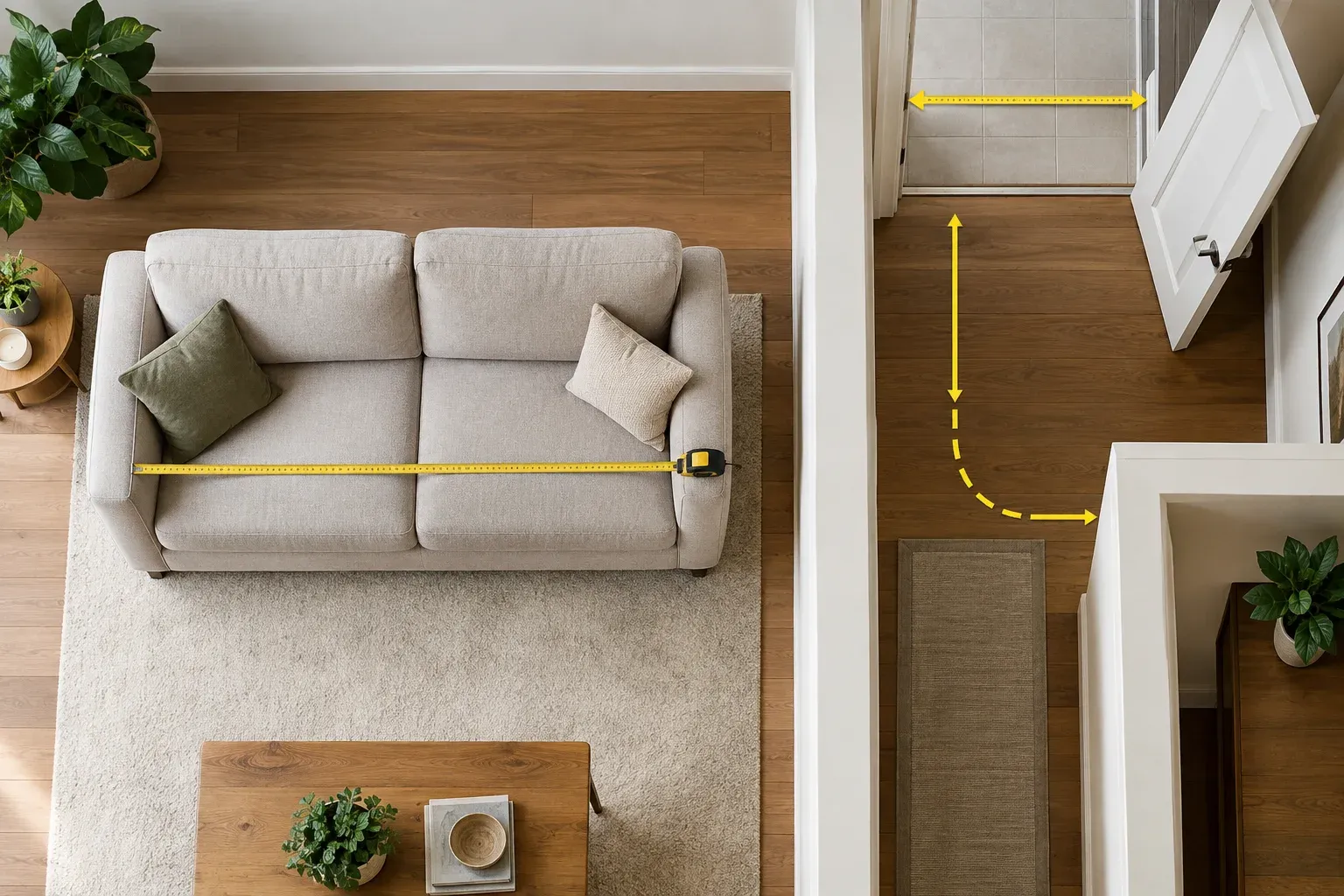
Record the overall width from one outer arm to the other, the deepest point from front to back, and the height from floor to the highest fixed part of the back. Measure without compressing cushions or excluding protruding fixed parts. If feet are removable, record both the current height and the likely height without them, but do not promise that they can be removed until checked.
For a corner sofa, measure each section and show how the pieces meet. For a chaise, state which side it occupies when facing the sofa. For a recliner or sofa bed, mention the mechanism and whether it is operating normally. These details help a removal provider decide what needs assessment before lifting begins.
Measure clear openings, not the door leaf
Measure the usable space between the fixed frame edges with the door fully open. Handles, closers, stops and nearby walls can reduce the practical opening. Note the height as well as the width. If a door leaf might need professional removal, raise that in advance rather than taking it off without permission.
Record corridor width and the distance from the doorway to the opposite wall. Photograph corners, ceiling drops, rails, light fittings and anything else that reduces turning space. Measurements guide planning; they do not guarantee a fit because the movement is three-dimensional and needs safe handling room.
Check whether the sofa separates into sections
Many corner and modular sofas are designed to split, but the connection is not always obvious. Sections may lift from metal hooks, slide apart, bolt together underneath or connect behind a fabric flap. Check the manufacturer’s instructions if available. Do not pull sections in opposite directions until you know how the connection works.
Remove only loose items you can handle safely, such as cushions. Put them aside so they do not block the route. Photograph any connector, cable or mechanism you can see without tilting the sofa. If the item is powered, reclines or contains a bed mechanism, tell the provider before the appointment.
Removable feet can change the clearance
Feet may unscrew, unbolt or be fixed as part of the frame. Removing them can reduce height and protect the floor, but forcing a stuck foot can damage the frame. Ask whether preparation is included and retain every fitting if the sofa is being moved rather than discarded.
Do not count soft cushions as structural clearance. The fixed frame is what must pass safely. Even after feet and cushions are removed, wide arms or a rigid back may remain the limiting dimension.
Plan the movement through the doorway
A straight carry is only one possibility. Depending on the sofa and space, experienced handlers may rotate it, stand it on an end, pass one arm through first or change its orientation at the threshold. The correct movement depends on weight distribution, construction and the clear space on both sides.
Do not attempt these movements alone. Sofas are awkward rather than merely heavy: the far end can swing into walls, glass, lights or another person. A person trapped between the sofa and a frame has little room to recover. Keep children and pets away and leave complex lifting to the agreed provider.
Protect the property before lifting starts
Clear tables, lamps, rugs, shoes and decorations from the route. Open agreed doors and secure them where appropriate. Point out delicate floors, narrow corners, glass panels, sprinklers and low fittings. Ask what protective materials and handling are included instead of assuming every surface treatment is automatic.
If the building has rules about corridor or lift protection, obtain them before the visit. Temporary padding must not obstruct fire equipment or shared access. The building’s instructions take priority over a general article.
When dismantling may be the practical option
If the fixed frame cannot follow an approved route, controlled dismantling may be considered. This can mean removing arms, separating a sectional frame or reducing an unwanted sofa into manageable parts. Whether that is appropriate depends on how the sofa is constructed and whether it must remain reusable.
Ask exactly what dismantling means in the quotation. Confirm whether reassembly is required, whether upholstery work is involved and what happens if concealed construction differs from the photographs. Do not assume a general collection price includes specialist furniture restoration.
Disposal and relocation require different decisions
An unwanted sofa may allow methods that would not preserve it for future use. A sofa being moved to another property needs protection, labelled fittings and a plan for reassembly. State the destination clearly. The sofa removal service is the relevant starting point for disposal enquiries; a relocation should be described as such from the first message.
Do not cut upholstery, saw timber or remove structural fasteners simply because the item is being discarded. Hidden springs, metal parts and mechanisms can cause injury. Ask the provider how an item that cannot leave intact will be handled.
Check every part of the building route
After the apartment door, assess the corridor, fire doors, lift lobby, service lift, stairs and loading point. A sofa that exits the room can still stop at a landing or lift entrance. Give the exact floor and say whether the lift has already been approved for the move.
For tower buildings, the service-lift booking guide explains the questions to ask management. Do not rely on passenger-lift dimensions or assume a booking can be made by the removal provider. Confirm the actual process for your building.
Stairs and alternative exits need assessment
Photograph landings, turns, railings and overhead restrictions. Give the floor number and describe any section without lift access. Do not treat a balcony, window or emergency route as an alternative without explicit building approval and a suitably qualified plan. An opening visible from the room is not automatically a safe removal route.
If an external lifting method is suggested, stop and obtain a specific professional assessment. Access, equipment, exclusion zones and building permission cannot be settled by a generic checklist.
Send a complete sofa-removal request
Include the sofa type, approximate dimensions, photographs from several angles and a picture of any sectional connection. Add images of the room door, tightest turn, apartment entrance, lift or stairs and loading access. State the floor, building instructions, deadline and whether the sofa must remain usable.
Mention damage, loose components, recliner mechanisms, sofa-bed frames or anything else that changes handling. If you are unsure about a measurement, label it approximate. Accurate uncertainty is more useful than a confident but incorrect figure.
Ask the provider to confirm the planned scope against that information. A useful confirmation addresses access, any expected dismantling, what preparation you must complete and what happens if the actual construction or route differs.
Prepare the room without attempting the difficult move
Remove personal belongings from the sofa and check beneath loose cushions. Clear the route and arrange building access. Keep parking or loading instructions ready for the attending team. Do not drag the sofa toward the doorway to prove that it will not fit; that can damage floors and leave the item in a less workable position.
If another person will provide access, share the photographs and agreement with them. They should know which item is leaving, whether it is for disposal, and what work was confirmed. This prevents a representative from approving an unplanned method under time pressure.
Common mistakes that make the job harder
The first is measuring only the door width. The second is failing to mention the turn beyond it. Others include assuming every corner sofa separates, booking collection before building access is approved, and saying “standard sofa” when the item is a recliner or sofa bed.
Another mistake is removing doors or hardware before responsibility is agreed. Altering a rented property or common-area fitting may require permission and proper reinstatement. Describe the obstruction first and let the relevant property contact and provider decide the sequence.
Finally, do not promise that a sofa can be donated or reused merely because it looks acceptable. Condition, hygiene, demand, transport and recipient criteria all matter. Ask about the intended disposal route without inventing a guaranteed outcome.
A practical decision path
First, identify the sofa configuration and whether it must remain reusable. Second, measure the fixed frame and all clear openings. Third, check modular connections and removable loose parts. Fourth, document every turn from the room to the loading point. Fifth, confirm building access. Then send the complete evidence for assessment.
If the sofa can move intact, the job becomes a handling and protection plan. If it separates as designed, label the sections and retain fittings where necessary. If neither works, obtain a clear dismantling scope. If the route itself is unavailable, resolve that access problem before setting the collection time.
Once the method is confirmed, keep the route clear and report any change before arrival. A measured, photographed route gives the provider something concrete to plan around and is the fastest way to turn “it will not fit” into a workable removal decision.
FAQs about sofas that will not fit
Can removing the sofa feet solve the problem?
Sometimes, but only when height or a small diagonal clearance is the limiting factor and the feet are designed to come off. It will not solve a long rigid frame that cannot turn. Photograph the feet and ask before forcing them.
Should I remove the apartment door myself?
Only if you have authority, the correct knowledge and a plan for safe reinstatement. Door weight, closers, hinges and fire-rating requirements may matter. Raise the option with building management and the provider first.
Can a corner sofa usually be separated?
Many can, but not all use the same connection. Look for manufacturer guidance and photograph accessible connectors. Do not pull or tip the sections until the release method and weight are understood.
What if the sofa fits the door but not the lift?
Provide the lift-door and car dimensions, photographs and the building’s approved alternative. The provider may assess stairs or another permitted route. Do not assume a passenger lift, balcony or emergency exit may be used.